
High-Performance Open-Source Archive
This R package provides a class that generates experiment sFFLHD designs. Sequential full factorial-based Latin hypercube design were created by Duan, Ankenman, Sanchez, and Sanchez (2015, Technometrics).
To create a new design you use the function sFFLHD$new
and must give in the number of dimensions, D, and the batch
size/number of levels per factor, L. An example is shown
below (the last line can be repeated when run in console to see how new
batches are added).
library(sFFLHD)
#> Loading required package: DoE.base
#> Loading required package: grid
#> Loading required package: conf.design
#>
#> Attaching package: 'DoE.base'
#> The following objects are masked from 'package:stats':
#>
#>     aov, lm
#> The following object is masked from 'package:graphics':
#>
#>     plot.design
#> The following object is masked from 'package:base':
#>
#>     lengths
set.seed(0)
s <- sFFLHD$new(D=2,L=3)
plot(s$get.batch(),xlim=0:1,ylim=0:1,pch=19)
abline(h=(0:(s$Lb))/s$Lb,v=(0:(s$Lb))/s$Lb,col=3);points(s$get.batch(),pch=19)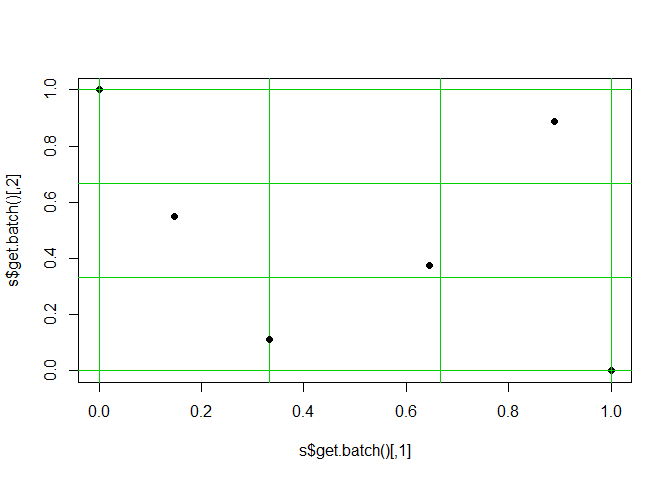
By default the new points are selected using maximin distance
optimization to spread them out. This is why points will end up near
corners. This option will slow down the code a little but generally not
noticeably compared to what the design is used for. If set to
FALSE then the points are randomly placed within their
small grid box.
Need mirroring services?
Contact our team at info@vpspulse.com.
Mirror powered by VPSpulse
Infrastructure sponsored by VPSPulse & Secure Payments by ArionPay.