
High-Performance Open-Source Archive



This package provides functions to compute the potential model as defined by Stewart (1941). Several options are available to customize the model, for example it is possible to fine-tune the distance friction functions or to use custom distance matrices. Some computations are parallelized to improve their efficiency.
You can install the released version of potential from
CRAN
with:
install.packages("potential")You can install the development version of potential
from GitHub with:
# install.packages("remotes")
remotes::install_github("riatelab/potential")library(mapsf)
library(potential)
# Display the spatial interaction function
plot_inter(fun = "e", span = 75000, beta = 2, limit = 250000)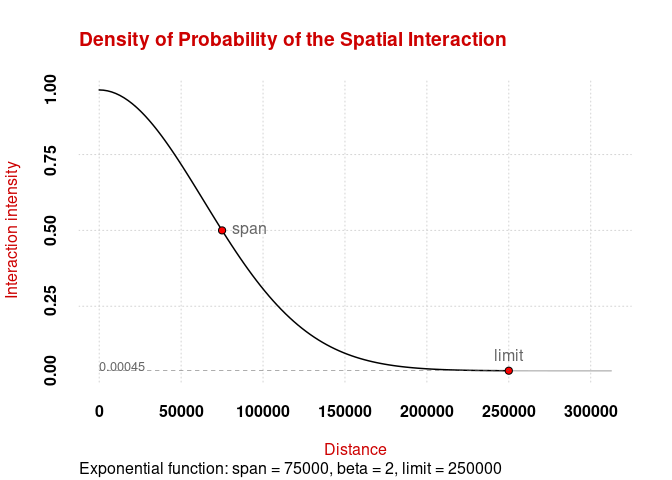
# create a regular grid
y <- create_grid(x = n3_poly, res = 20000)
# compute potentials
pot <- mcpotential(
  x = n3_pt, y = y,
  var = "POP19",
  fun = "e", span = 75000,
  beta = 2, limit = 250000,
  ncl = 2
)
# Define potential according to the maximum value
y$pot <- pot / max(pot) * 100
# create equipotential areas
bks <- seq(0, 100, length.out = 11)
equipot <- equipotential(y, var = "pot", breaks = bks, mask = n3_poly)
# map potentials
mf_map(x = equipot, var = "min", type = "choro",
       breaks = bks,
       pal = hcl.colors(10, 'Teal'),
       border = "#121725",
       leg_val_rnd = 0,
       lwd = .2,
       leg_pos = "topright",
       leg_title = "Potential Intensity")
mf_title(txt = "Potentials of Population")
mf_credits(txt = "© EuroGeographics for the administrative boundaries and © Eurostat for data")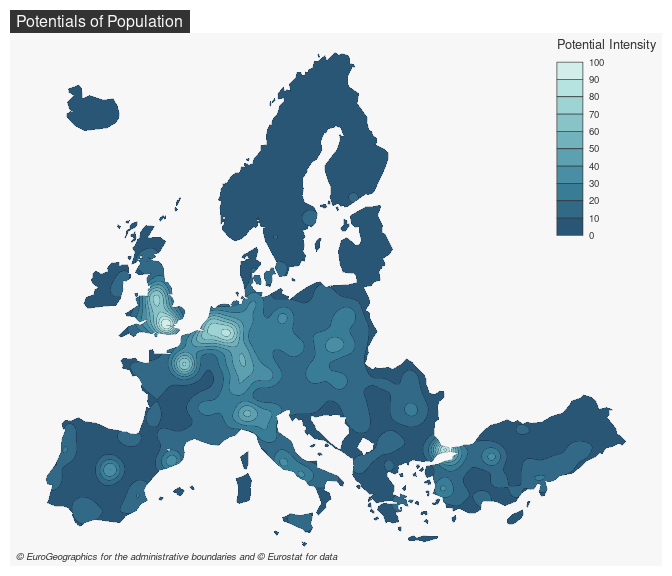
This package provides access to the revamped potential-related
functions initially offered by SpatialPosition.
Need mirroring services?
Contact our team at info@vpspulse.com.
Mirror powered by VPSpulse
Infrastructure sponsored by VPSPulse & Secure Payments by ArionPay.